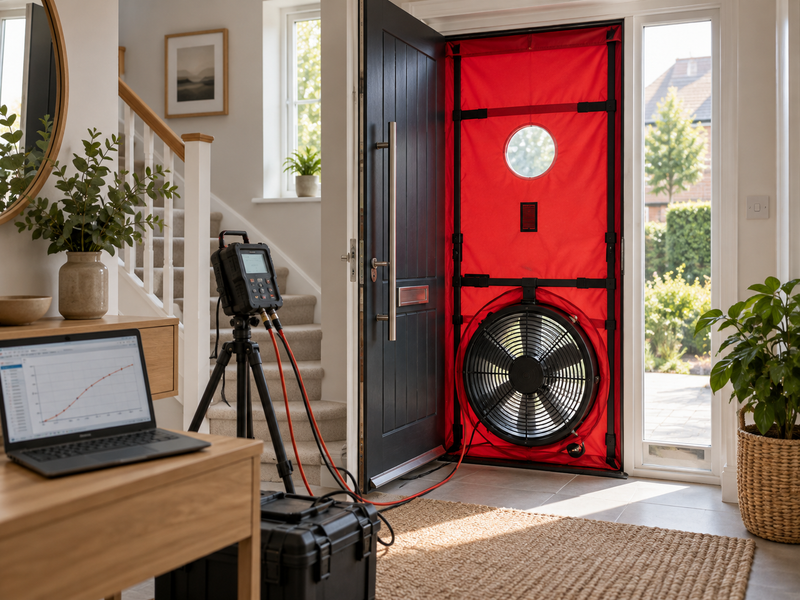
Air Leakage Testing
Air Leakage Testing & Air Tightness Testing
Crowther Solutions provides Air Leakage Testing for new dwellings to help demonstrate compliance with Part L airtightness requirements.
The required air permeability target is project-specific. In addition to the minimum Part L requirements, the dwelling may need to achieve a lower air permeability target established by the SAP assessment. The measured test result is then used within the final As-Built SAP assessment and New Dwelling EPC.
We manage the testing process directly, including site coordination and the required project information, working with a trusted registered air tightness tester who completes the formal test and certification. This gives clients a single point of contact through Crowther Solutions from SAP assessment through to completion testing.
Preparing for an Air Leakage Test
Pre-test checklist:
Before the test, check that:
- Windows and external doors are fully fitted, sealed and able to close properly.
- Draught seals are fitted and window/door frames are sealed to the surrounding construction.
- Skirting boards and floor junctions are sealed, particularly with timber-frame construction or dot-and-dab plasterboard.
- Service penetrations around pipes, cables and ducts are permanently sealed.
- Concealed leakage paths behind kitchens, sanitaryware, bath panels and cupboards have been sealed.
- Dot-and-dab plasterboard has a continuous airtight seal at the top, bottom, corners and around openings and penetrations.
- Electrical sockets, light fittings and other penetrations through the airtight layer are appropriately sealed.
- Loft hatches are properly fitted and include effective airtight seals.
- Good quality air tight loft hatch
Any temporary sealing carried out purely to achieve a better test result may not be permitted, so the dwelling should be presented in its normal completed condition with permanent airtightness measures in place.
Blockwork Alone Does Not Provide a Reliable Airtight Layer
Masonry blockwork should not be assumed to provide the airtight layer on its own. Air can pass through joints, service penetrations and gaps in the construction, particularly where plasterboard is installed using dot-and-dab adhesive.
Where internal plaster or plasterboard forms part of the airtightness strategy, continuity is important. Dot-and-dab plasterboard should have a continuous perimeter seal at floors, ceilings, corners, openings and around service penetrations so that air cannot bypass the finished surface.
Practical Air Leakage Guidance
Our air tightness tester is experienced at identifying likely leakage points while on site. If the dwelling does not initially achieve the required target, they can help identify areas where air leakage may be occurring so the site team can carry out suitable remedial sealing.
Where the necessary work can be completed within a reasonable time during the same visit, the property can be re-tested on the day, helping avoid the delay and additional cost of arranging a separate return visit.
What Our Air Leakage Testing Service Includes
Site Coordination: We arrange the testing visit and manage the project information directly with our trusted air tightness tester.
Air Leakage Test: The dwelling is pressure tested against the required air permeability target by a suitably registered tester.
On-Site Leakage Investigation: If the dwelling does not initially achieve the target, the tester can help identify likely leakage areas so the site team can carry out remedial sealing.
Same-Day Re-Test Where Practical: If the necessary remedial work can be completed within a reasonable time during the visit, the dwelling can be tested again on the same day.
Test Certification: Once the required result is achieved, the formal air leakage test certificate is issued for use with the As-Built SAP assessment, New Dwelling EPC and Building Control submission.
How Long Does an Air Leakage Test Take?
We generally allow up to approximately 45 minutes per plot, excluding initial setup and time moving between plots. This normally provides sufficient time to complete the test and, where necessary, investigate likely leakage areas.
If a dwelling initially fails and the site team can carry out suitable remedial sealing within a reasonable time, our tester will aim to re-test during the same visit. In some cases, spending additional time resolving leakage on one plot can be more productive than continuing to test several plots with the same unresolved issue.
Request an Air Leakage Test Quote
Send us your project details, site location and number of plots and we’ll review the testing requirements and provide a project-specific quotation. Crowther Solutions manages the process directly, giving you a single point of contact from SAP assessment through to final air leakage testing and certification.